
How Vouchers and Packages Turn Your Dead Season into Prepaid Revenue

Hoteliers spend money every year to be visible on OTAs, chasing algorithm changes, paying commissions on every booking, and competing with their competitors. But one channel is almost flying under the radar: vouchers and packages, the only source of prepaid, commission-free revenue, often booked months before a guest checks in. Most properties still treat vouchers as a side task rather than a profit center.
That blind spot is costly. Gift and travel redemption rates vary widely, with some vouchers going unused up to 70% of the time. NFS Hospitality estimates 2023 breakage typically at 10-19% of total value sold. The gap comes down to voucher type: high-value, single-purpose vouchers (like a spa package) see more non-redemption than flexible, lower-value ones (like a $25 dining credit). Either way, the margin is real. Roughly 10% to 30% of what you sell can end up as pure profit at no additional cost.
The mechanism is simple: a voucher is cash the hotel already has, and the timing of redemption makes it a fundamentally different kind of revenue from a booking. That's the point for cash flow.
Why Prepaid Revenue Beats Booked Revenue
Prepaid revenue arrives with no collection risk and cash to reinvest before anything is owed. Booked revenue is just recognition on paper. It can still go unpaid, be canceled, or be discounted before the guest checks in. That distinction applies only to one of the two mechanics this article covers, and it's worth being precise about which one.
Prepaid by Design: Where Vouchers and Packages Diverge
A voucher is paid at the time of sale, regardless of the stay date, making it prepaid revenue. A hotel package is usually just a bundled rate attached to a reservation: still booked, still cancellable, with cash arriving only at check-in or check-out, exactly like the booked revenue this article argues against. Selling a package doesn't make it prepaid. Only selling it as a voucher, paid in full upfront and redeemed later, does.
For the packages section to deliver on the "prepaid" promise in this headline, packages must be structured and sold as prepaid package vouchers, not bookable rate plans with a nicer name. That distinction separates two genuinely different levers: vouchers protect cash flow, packages protect margin by raising average spend per stay. Conflating the two is where this argument falls apart under scrutiny.
Vouchers Beat Bookings on Cash Certainty
A reservation is merely a promise. Guests can cancel, OTAs take 15-25% commission before a dime ever reaches the hotel, and seasonal fluctuations can quietly whittle away at the promise before the stay even occurs. A voucher takes away that uncertainty. Payment is taken up front, regardless of whether it is redeemed. Selling direct through a hotel's own shop offers zero commission, zero cancellation risk, and positive cash flow when a property needs it most.
In many markets, a large share of voucher sales still runs through third-party marketplaces (regional voucher and deal platforms, or global players like Groupon) that take 20-30%+ per sale. "Commission-free" is only for direct sales, not marketplace sales. And taking that route is intentionally trading margin for reach. But to ignore that trade-off destroys the credibility of the argument for anyone who has actually sold through one.
Unredeemed Vouchers: A Quiet Profit Line for the CFO
There is also voucher breakage: the percentage of vouchers purchased that never get redeemed. It works in the hotel's favor, since they receive payment without incurring the cost of providing the stay. The figures below are shown in USD, which is used here as a globally recognized reference currency.
Vouchers sold this season: $50,000, redeemed at 85%, nothing due on it. No room night, no spa slot, no welcome drink. $7,500 kept.
Vouchers sold: $50,000 at 85% redemption = $42,500 delivered against real staysVouchers unredeemed: $50,000 at 15% breakage = $7,500 retained as pure margin
That $7,500 is not abstract. A small independent property normally has about $3,000-4,000 a week in front desk and housekeeping payroll, so $7,500 in breakage is enough to cover about two weeks' worth of that in cash before a single room from that batch is occupied. That's what "payroll coverage" is really about: an exact number of weeks a property can cover payroll without needing occupancy to catch up.
The Psychology of Vouchers: Why “Dinner for Two + Spa Evening” Outperforms a $100 Gift Certificate
Two vouchers can be priced the same and have the same margin and sell totally differently. Buyers respond to the story, not the number. A flat-value gift certificate is like a rebate. "Dinner for Two + Spa Evening" creates a moment, relieving the buyer of the effort of deciding what to do with the money.
It also keeps prices up by moving the conversation from unit cost to total value; a quiet weekday spa slot is effectively free, but presented as a “Spa Evening for Two”, it feels premium and is priced like it, monetizing slow periods much better than a simple listing.
The payoff: stronger emotional pull, easier sell, more upsell and repeat redemption. Four types consistently deliver this:
- Romantic Getaway - room with a curated add-on, sold as a single occasion.
- Gourmet/Dinner - an easy, premium-priced gift that attracts first-time guests.
- Wellness Day - spa access and treatments, packaging off-peak capacity at premium perceived value.
- Open Arrival-Date Stay Voucher - a flexible timing prepaid stay trading buyer flexibility for cash.
The Voucher Calendar: When People Actually Buy

Voucher demand varies by market, season, and customer segment. The peaks tend to fall around your market’s major gifting occasions, such as Christmas and New Year in the West, Lunar New Year in China and East Asia, Diwali in India and South Asia, or Singles’ Day for e-commerce-led gifting in China, in addition to other culturally important seasons for your guests.
Smaller secondary spikes tend to cluster around dates specific to the region such as Valentine’s Day, Mother’s Day or local public holidays. Properties are available prior to that calendar capture demand. Instead, they launch mid-peak season, competing for attention during the busiest week.
The Global Gifting Calendar
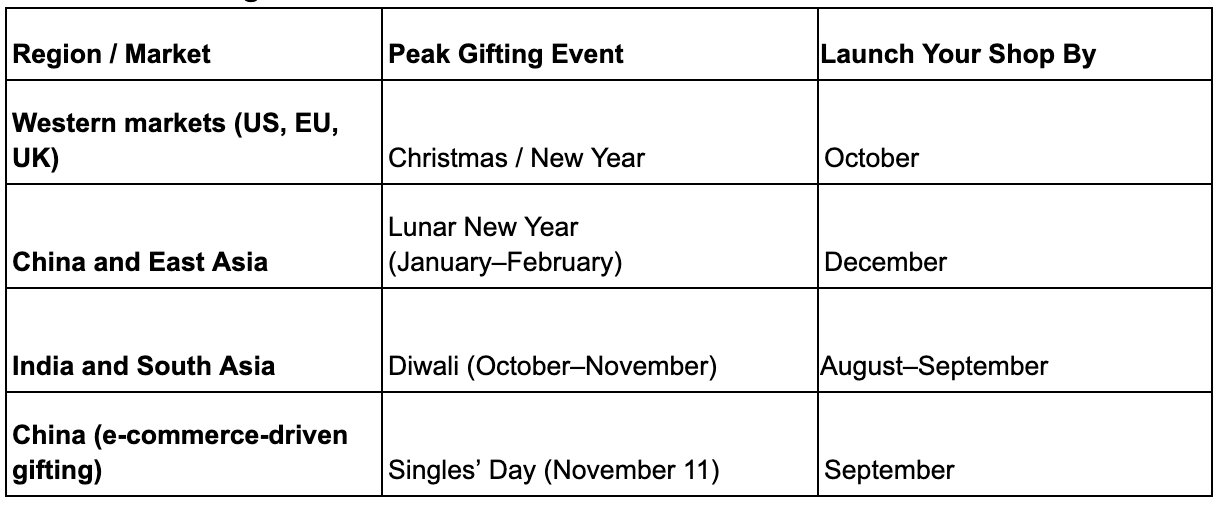
Get your voucher shop live before the launch date that matches your market's calendar, not the default Western one, and you capture demand your competitors are still fighting for during the busiest week of the season.
Timing the Launch, Timing the Redemption
Urgency is less important than timing. Whatever your market’s main gifting season - Christmas, Lunar New Year, Diwali, or Singles’ Day - your voucher shop should be live well before it, based on the calendar above rather than launched at the last minute. Shoppers tend to plan their gift-giving weeks in advance, and a rushed launch has to compete for attention during the busiest part of the season.
Marketing should be post-readiness, not pre. Marketing and pricing only work with the shop open. You can even out the slower months with peak-season voucher sales by creating windows of validity and redemption rules to manage demand and create steadier revenue streams throughout the year.
Packages: Pre-Selling the Low Season at Full Margin
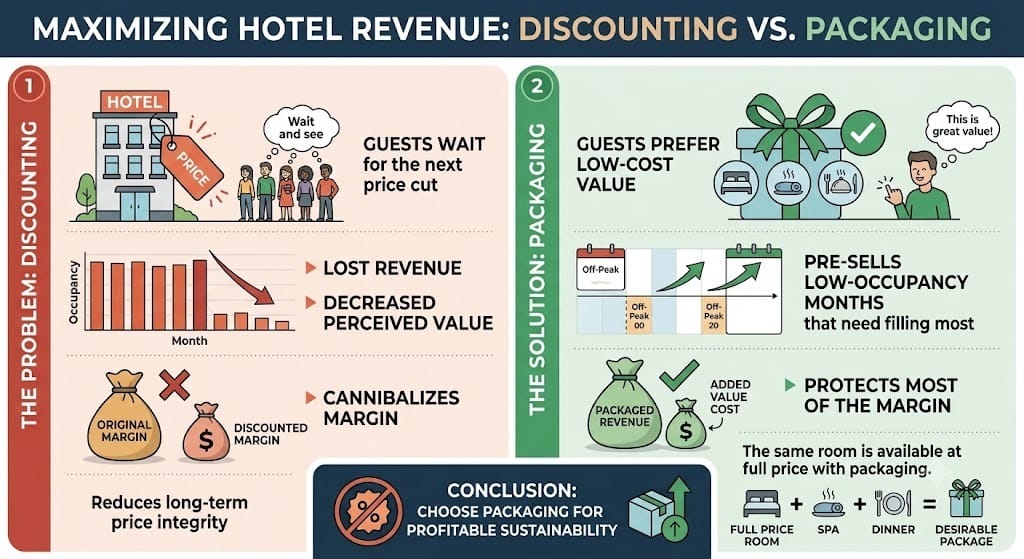
Discounting causes guests to wait for the next price cut. The same room is available at full price with packaging, but it is low-cost value that the guest really wants. Packaging protects most of the margin and the months that need filling most.
Why Packaging Beats Deep January Discounts
$48 in lost revenue from one room isn't 40% off a $120 room (down to $72). It's a signal: the slow-season guests know there's always a discount, so they wait for it, pulling demand out of the full-rate weeks surrounding the sale, too.
Packaging avoids that trap, keeping the price constant but adding value instead: a welcome drink, late check-out or spa access, at low marginal cost. The flat rate is good for ADR and makes guests feel like they are getting a little something extra instead of paying more.
Discounted room: $120 − 40% = $72 revenue, ADR downPackaged room: $120 + welcome drink, late check-out, spa slot (marginal cost: $15-18) = $102-105 net, ADR untouched
Since the rate is fixed, guests never expect to get a discount, and the rooms continue to be filled during the critical weeks. The two levers are not compatible. The discount lever gives up $48 in straight revenue while the packaging lever gives up only $15-18 in marginal cost for the extras. That's a difference of about $30-33 per room. The discount is not the real cost of pulling the wrong lever; that gap is.
Three Low-Season Packages to Have Ready
There are better ways to fill low-season rooms than discounting, and packaging often works better:
- Midweek Workation Package - desk, WiFi, quiet space, filling weak Monday-to-Thursday demand.
- Seasonal Experience Package - tied to a local event, giving guests a reason beyond the room.
- Flexible “Escape” Package - open dates sold in high season, redeemed later as low-season occupancy.
Selling January in July
The mechanism behind "selling January in July" deserves more than a vague nudge to "encourage guests to book" - and the phrase itself is just a stand-in for whatever low-season/high-season pairing applies to your property, wherever that falls on the calendar. Here's a concrete playbook instead.
Trigger point 1: At checkout. A QR code at the front desk, offered while the guest is still in a positive, trust-heavy state and hasn't yet slipped back into their normal routine. It's the highest-intent moment available. It's also the easiest to fumble if it's handed over as an afterthought with the folio.
Trigger point 2: A post-stay email, 48 hours after departure. Not on checkout day, when the guest is still traveling or catching up on work, and not a week later, once the stay has faded. Two days out is close enough to still feel vivid, far enough that the guest has had time to miss it.
The mechanics are important, but so is the presentation. Back for our “Winter Escape" is predictable, but it's warm, and it delivers. A better line would be something like “Your room’s waiting for you this season with a little extra”. That version ties the offer to something the guest has had, not to some future guest who has not been.
The Fine Print That Protects Your Margin
Vouchers are real financial and legal liabilities, not a marketing gimmick. A sale is to be treated as a liability until it is fulfilled and the terms of validity are determined by the legislation of the country of issue. These rules differ significantly from one country to the next, so treat everything below as an illustration of how one jurisdiction handles it, not a global standard.
It’s the rules of redemption that determine whether a voucher fills an empty Tuesday slot or replaces a full Saturday slot. If there’s a real upside to be captured, get the fine print right and avoid unpleasant surprises down the line.
Validity Periods: Know the Legal Floor
It's not merely a selling point, but can be a legal necessity, and the legal floor for how long a voucher must remain valid differs significantly from market to market. There's no single global standard, so the rules need to be checked wherever a property operates:
Europe
- Germany: In general, vouchers are valid for three years – regardless of what the voucher says. This could mean unredeemed value sits on the books longer than anticipated.
- Rest of EU: The limitation periods are set by other member states, and therefore the German example should not be seen as a model for the entire EU.
- United Kingdom: Free from EU rules post-Brexit. The UK does not have a fixed minimum period of validity as in the German limitation rules, but the Consumer Rights Act and general fairness rules mean that very short or hidden expiry terms can be challenged as unfair.
Asia
- Japan. Special consumer protection laws for prepaid vouchers and gift certificates require them to be registered and valid.
- India: No specific national law on gift vouchers as such. Instead, validity and refund requirements are spread across the Consumer Protection Act and RBI rules for prepaid instruments, illustrating the country’s fragmented regulatory framework.
- China: Single-purpose prepaid vouchers are regulated at the local/municipal level in many cities, with registration and minimum-validity requirements that differ by city rather than being set nationally.
- Other Asian markets: Some leave expiration largely up to the issuer, subject only to general consumer protection or contract law, so the legal floor has to be checked on a market-by-market basis rather than assumed.
North America
- United States: The CARD Act limits gift card expiration dates to the date of purchase, plus five or more years.
- US states: Some states go further than federal law to ban expiration altogether or eventually require unredeemed balances to be reported as unclaimed property (escheatment).
- Canada: Provincial, not national, regulation. Ontario and Quebec generally prohibit expiration dates on gift cards, but other provinces have their own, sometimes more relaxed rules.
Other notable markets
- Australia: One of the more prescriptive regimes, with national consumer law setting a minimum three-year validity period for most gift cards and vouchers, subject to limited exemptions.
- UAE / broader Gulf region: Consumer-protection rules around prepaid vouchers have been tightening, though the framework is newer and less standardized than the EU or US.
- Brazil: Consumer protection laws (Código de Defesa do Consumidor) are viewed as requiring reasonable and transparent expiry dates, and regulators are generally relatively pro-consumer in dispute resolution.
The takeaway is the same everywhere: unredeemed value may sit on the books far longer than a property first anticipated, and the applicable floor is always set by the laws of the jurisdiction where the property operates, not by the terms printed on the voucher. Validity periods should be set property-by-property, market-by-market, rather than copied from one country's rules and assumed to apply. But there's more to a marketing strategy than that.
Single-Purpose vs. Multi-Purpose Vouchers: Know the Tax Trigger
Not all vouchers are treated equally for tax purposes, and the distinction affects when tax becomes due: at sale, or only at redemption. The rule differs by market:
Europe
- EU VAT law makes a distinction between a “single-purpose voucher” (where the supply and VAT rate are known at the time of sale, e.g. a particular room type at a particular property) and a “multi-purpose voucher” (redeemable against services or properties, with the details fixed only at redemption). The latter is sold free of VAT. The latter defers it to redemption.
- Germany is the classic example: Einzweckgutschein vs. Mehrzweckgutschein, an area tax authorities specifically audit.
- The rest of the EU follows the same framework, though enforcement varies by country.
Asia
- Japan uses the same logic and links the consumption tax to how well defined the underlying service of the voucher is at the time of sale.
- India’s GST guidance likewise distinguishes between vouchers for a fixed supply and those redeemable against multiple goods or services.
- China ties the timing of tax to local invoicing rules and if the voucher shows a fixed service at sale.
North America
- United States does not have a VAT/GST system, so this exact distinction does not exist. In most cases, sales tax is collected at redemption, because the sale of the voucher is not a taxable event.
- Canada likewise taxes at redemption under GST/HST, not at the time of sale.
The principle holds everywhere: whether tax is due at sale or redemption depends on how specifically the voucher defines what's being purchased. Misclassifying it shifts the reporting period for when tax is owed. Verify treatment with a local tax advisor in each country before launch, not after a tax authority flags it.
Vouchers: From Ledger to Front Desk
When a voucher is sold, it isn't income but deferred revenue, treated as a liability until redeemed, at which point revenue is recognized. Breakage shouldn't just sit unclaimed and forgotten until expiry or land as an unplanned P&L windfall. Properties should instead systematically account for historical redemption patterns.
Redemption Rules: Protect Your Best Weekends
Same discipline for writing as for salvation. A free (unrestricted) voucher is simply a discount off full price on your best weekends. Blackout nights on premium nights. Guests are invited to take a little bonus midweek with weekday stays. It is added value, not a constraint of choice.
When Vouchers Backfire:
Vouchers aren't a lever that only ever helps. Pretending otherwise reads like marketing, not analysis. It's worth being honest about where it can backfire:
- Redemption can be lumped together instead of spread out. If redemptions from the same gifting event bunch up in the same high-demand weeks, then ‘prepaid revenue’ becomes an occupancy problem.
- The cash is frequently gone before the service is due. Voucher revenue is often spent on payroll, marketing, or the next slow month before the stay is delivered. Weak forecasting can leave a property with more room nights owed than it can comfortably accommodate.
- A steeply discounted voucher is still a discount. Selling vouchers cheaply to move volume does the same ADR damage as the January discounting this article argues against; prepaid timing doesn't offset a cut-price.
None of this means the channel isn't worth running. It means vouchers need the same pricing discipline as any other revenue lever, not blind enthusiasm just because the cash arrives early.
Measuring It: The Three Numbers That Matter
A voucher program can appear to be a success, and quietly nibble away at revenue. There are three metrics that differentiate real impact from a vanity metric: revenue share, redemption rate + incremental spend, and the seasonality gap between when vouchers are sold and when they are redeemed.
Benchmark: Voucher Revenue as % of Total Revenue
For independent properties, vouchers usually make up 2-5% of total revenue, a small but significant contribution. Brands push higher, either aggressively or as gift-card-driven strategies.
Don't judge the program by that percentage - a small share of total revenue can still be one of the most valuable levers a property runs, because the real payoff shows up in cash flow and guest acquisition, not in the top-line number. Used well, vouchers smooth out cash flow and bring in new guests who might never have booked otherwise.
Redemption Rate & Additional Spend: The Real Upside
The voucher does not expire after the first sale. Guests tend to spend more on upgrades, dining, spa treatments, or additional nights when they are on-site, and high redemption rates drive them there. You can track redemption and additional spend, see the impact on revenue, and improve your offers.
Sales-to-Redemption Gap: Filling Gaps or Cannibalizing Peaks?
Track the time gap between voucher sale and redemption. Buying a voucher in December and using it in busy July doesn’t create new demand. It’s just a booking that would have been made anyway. The gap tells you whether you’re actually filling real occupancy gaps or just moving revenue that was already coming in.
Vouchers Deserve a Real Strategy, Not an Afterthought
In essence, vouchers and packages are the hotel’s closest equivalent to selling futures on its own inventory: prepaid, direct, commission-free, and collected long before the room night is realized. If they’re done right, they smooth out cash flow and pre-sell the months when it’s needed most. But they typically come as an afterthought: no storefront, no automated delivery, no tracking, just a receptionist printing a PDF to order.
A real voucher shop is a working build, not a lobby poster. Online sales through the hotel site. Full payment at the POS and automatic e-voucher delivery with redemption flowing straight into the folio through the PMS.
The B2B Segment Most Hotels Ignore
Individual gifting isn't the only channel worth building for. Corporate and B2B gifting, bulk vouchers a company buys for employees, clients, or partners, is one of the fastest-growing parts of the global gift-card market, and it's a segment most hotel voucher programs never touch. Where a consumer buys one voucher, a company buys dozens or hundreds in a single order, often timed to year-end bonuses or client-appreciation campaigns rather than a personal occasion.
A voucher shop that only supports single purchases at checkout has no way to capture that volume; adding a bulk-order option with invoicing, not just card payments, is often enough to unlock it.
Multi-Currency and Local Payment Rails
A voucher shop built around a single currency and card payments quietly excludes a large share of the global gifting market. Buyers in China expect Alipay or WeChat Pay, buyers in the Netherlands expect iDEAL, and buyers across much of Europe increasingly expect Klarna or another buy-now-pay-later option at checkout - a shop that only takes Visa and Mastercard loses these sales before the guest ever sees a voucher type.
There's also a distinct, often-overlooked buyer: diaspora customers purchasing a voucher for family "back home," a gift bought from one country for redemption in another. That segment is rarely designed for, and rarely captured, but it's real demand sitting outside the usual local-guest assumption.
Where the Traffic Comes From
A well-built shop still needs buyers to find it. Three channels do most of the work. The hotel's own email list of past guests comes first: they already trust the property and convert at a far higher rate than cold traffic. A QR code at the front desk and on the folio catches guests at their highest-intent moment. Organic search around "gift experiences near me," or the local-market equivalent, captures buyers who were never going to search for the hotel by name.
Five steps to get there:
- Audit what's already happening. Pull a sample of 20-30 vouchers sold last season and check how each was sold, delivered, and redeemed. Most properties find the gaps immediately.
- Pick from the four voucher types that consistently sell. Romantic Getaway, Gourmet/Dinner, Wellness Day, or Open Arrival-Date Stay, rather than a single generic gift certificate.
- Establish redemption rules up front, not after. Validity period, blackout dates, and weekday incentives that drive redemption to the low-occupancy weeks.
- Launch by October. Shoppers decide what to buy weeks before the holiday that drives gifting in your market. For example, Christmas shoppers decide what to buy weeks ahead. A shop that’s live in mid-December is fighting for attention in the busiest, most crowded week of the gift-giving season.
- Measure the three numbers:
- Voucher revenue as a share of total revenue
- Redemption rate plus incremental on-site spend
- The gap between when vouchers are sold and when they're redeemed
Check your voucher setup this week. If a guest still has to call the front desk to buy one, and a receptionist still has to print it, the dead season is losing to a sales process, not a lack of demand. For properties ready to fix that, a tool like Hotelfriend's Package & Arrangement management handles voucher creation, redemption tracking, and payment collection in one place, rather than relying on a PDF and a spreadsheet.
Author: Anastasiia Lypchenko, Content Author at HotelFriend. As an avid traveler with a deep interest in hospitality, I monitor the latest trends and innovations shaping the industry. My interest lies in exploring how technology helps hotel businesses grow and succeed.